
OUPES
OUPES Mega 1 + 240W Panel
1,024Wh2,000W AC+240W solar
8.0The expandable underdog: 1,024Wh LiFePO4 with a 2,000W inverter, sub-20ms UPS switchover, and capacity that grows to 5,120Wh with extra batteries.
Updated June 2026

Dominick DePaola
Off-grid power editor at RoverSolar
Backup power gets judged on different math than camping power. Weight barely matters; what matters is capacity (can it carry your fridge and essentials through the outage?), surge handling (can it start a compressor or sump pump without tripping?), UPS switchover speed if you're protecting desktops or medical gear, and how fast it refills — from the wall before a storm, or from solar during a long outage. Chemistry is non-negotiable here: a backup battery sits at the ready for years, and LiFePO4's 3,000–3,500 cycle life and tolerance for sitting charged make it the only sensible choice. Every pick below is LiFePO4.
Size against reality. A fridge runs at 50–60W but surges hard at compressor start and averages roughly 1–1.5kWh per day; add a router, phones, lights, and a fan and most households burn 2–3kWh of essentials daily. A 1kWh unit is a one-room, one-day solution; whole-kitchen, multi-day backup starts at 3kWh, especially with solar to extend it.
OUPES
The expandable underdog: 1,024Wh LiFePO4 with a 2,000W inverter, sub-20ms UPS switchover, and capacity that grows to 5,120Wh with extra batteries.
BLUETTI
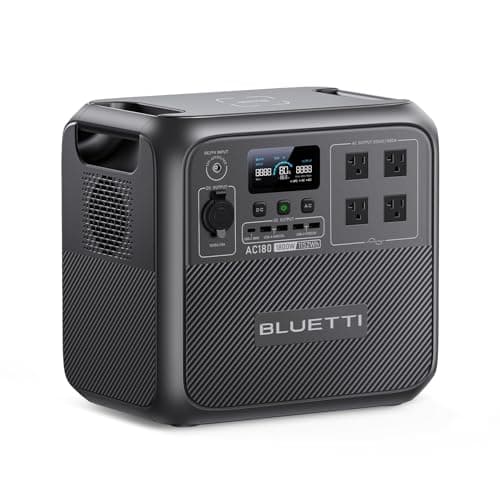
Our favorite all-rounder: 1,152Wh of LiFePO4, a real 1,800W inverter, and fast wall charging at a price that routinely undercuts the big names.

Anker
Anker’s refined 1kWh station: 1,024Wh LiFePO4 pushing 2,000W (3,000W peak) with ultra-fast recharging and a quieter thermal design.

ECO-WORTHY
3,584Wh of storage with Bluetooth monitoring and low-temp charge cutoff — the affordable backbone for an RV or cabin battery bank.
For genuine multi-day outage coverage, this is the kit we'd put in our own garage. The 3,072Wh LiFePO4 pack runs a fridge plus router, lights, phones, and a fan for a full day and more, and the 3,600W inverter with 7,200W surge starts a fridge compressor and a sump pump at the same time without flinching — the surge headroom is what separates it from 1kWh-class units that trip on motor starts. The bundled 400W of folding solar is the multi-day answer: in decent sun it harvests enough to replace a fridge's daily draw, making the system outage-self-sufficient rather than a countdown timer. Trade-offs: 60 lb means it lives where it works, and it's honest overkill if your outages run hours, not days. For storm country, it's the standard.
If the gear you're protecting can't tolerate even a blink — desktop computers, CPAPs, aquariums, network equipment — the Mega 1's sub-20ms UPS switchover is the feature that matters, and it's the best implementation at this price. Plug the load into the unit, the unit into the wall, and an outage simply doesn't register. The base 1,024Wh LiFePO4 pack with a 2,000W inverter and a huge 4,000W surge covers the essentials, and the expansion path to 5,120Wh means you can grow into multi-day capacity later instead of buying it all up front — something neither the Jackery kit nor the AC180 offers. The included 240W panel adds outage solar. The trade-offs: OUPES's support network is thinner than the big three brands, and the app is clunky. For always-on loads, accept that trade.
Most outages are hours, not days, and most households need one room kept alive — the fridge, the router, some lights, the phones. The AC180 is the right tool for exactly that: 1,152Wh of LiFePO4 and an 1,800W inverter with 2,700W surge that starts a fridge compressor without complaint. It runs a typical fridge 12–18 hours on battery alone, longer with loads managed, and its 500W solar input is the highest in the 1kWh class here — add panels and it becomes a long-outage tool. It also moonlights as a camping station, which the 60 lb Jackery kit never will. The trade-off versus the kits above is capacity and the lack of fast UPS switchover for sensitive always-on gear. As one do-everything unit with a 5-year warranty, it's the value play.
Storm coming, battery flat? The C1000 Gen 2's roughly one-hour full wall recharge is the headline here — the AC180 needs about 45 minutes just to hit 80%, and most rivals take several hours for a full tank. That speed turns weather-warning windows into full readiness. Beyond it: 1,024Wh of LiFePO4, the strongest inverter in the 1kWh class at 2,000W with 3,000W surge, six AC outlets so the fridge, router, lamp, and chargers all plug in directly without a power strip, and a 600W solar input ceiling for outage harvesting. The trade-offs are modest — slightly less capacity than the AC180, some settings buried in the app, and typically a higher price. Buy it if recharge speed and outlet count fit how you ride out storms; otherwise the AC180 delivers more watt-hours per dollar.
Per watt-hour, nothing on this page touches it: 3,584Wh of LiFePO4 — more raw storage than the Jackery HomePower 3000 — at a fraction of the cost of a finished station. The catch is the word "finished": this is a bare 12V battery, so you supply the inverter (the Renogy 1000W pure sine unit pairs naturally), cabling, fusing, and a charger or solar controller. What you get for the homework: a built-in 200A BMS with low-temperature charge cutoff, Bluetooth state-of-charge monitoring from your phone, and a 5-year warranty on the expensive part of any backup system. At roughly 60 lb it gets installed once, not carried. Buy it if you enjoy the project and want maximum runtime per dollar; buy a turnkey kit above if you want backup working this afternoon.
| Spec |  | | | |
|---|---|---|---|---|
| Capacity | 3,072 Wh | 1,024 Wh | 1,152 Wh | 1,024 Wh |
| AC output | 3,600 W | 2,000 W | 1,800 W | 2,000 W |
| Surge | 7,200 W | 4,000 W | 2,700 W | 3,000 W |
| Chemistry | LiFePO4 | LiFePO4 | LiFePO4 | LiFePO4 |
| Weight | 60 lb | — | 35.3 lb | 27.6 lb |
| Solar input | — | — | 500 W | 600 W |
| Panel | 400 W | 240 W | — | — |
| Warranty | 5 yr | 5 yr | 5 yr | 5 yr |
| Check Price at JackeryCode POWER3000 at checkout | Check Price on Amazon | Check Price at BLUETTICode AFF5OFF at checkout | Check Price on Amazon |
A modern full-size fridge draws about 50–60W while the compressor runs, but it cycles on and off, averaging roughly 1–1.5kWh per day — and it surges to several hundred watts at compressor start, so surge rating matters. Practically: a 1kWh unit like the AC180 runs a fridge 12–18 hours, while the 3kWh HomePower kit covers two days or more, indefinitely with its solar panels in decent sun.
A traditional UPS switches to battery in milliseconds but holds only minutes of runtime; a power station holds hours or days but most models take long enough to switch that a desktop reboots. Units with true fast switchover — the OUPES Mega 1 transfers in under 20ms — do both jobs: seamless protection for computers and medical gear, plus real capacity to ride out the outage afterward.
Usually, if the inverter's surge rating is up to it. A typical 1/3 HP sump pump runs at 700–800W but can surge to 1,500–2,000W or more at motor start. The HomePower 3000's 7,200W surge and the Mega 1's 4,000W handle that comfortably; smaller stations may trip. Budget roughly 1–2kWh per day of heavy pumping, and add solar if storms in your area knock power out for days.
For LiFePO4 units with UPS or pass-through modes, yes — that's the design intent, and the chemistry tolerates sitting at high charge far better than older Li-ion. The unit powers your loads from the wall and switches to battery when the grid drops. If you store it unplugged instead, keep it around 50–80% charge and top it up every two to three months so it's never deeply discharged when you need it.
Add it up: a fridge averages 1–1.5kWh daily, a router and modem about 0.25kWh, LED lights and phone charging another 0.25–0.5kWh, a fan or CPAP 0.3–0.5kWh more. Most households land at 2–3kWh per day of true essentials. That means a 1kWh station covers roughly half a day to a day with discipline, while a 3kWh system plus 400W of solar can run essentials indefinitely in sunny weather.