Jackery vs BLUETTI: Which Brand Wins in 2026?

Dominick DePaola
Off-grid power editor at RoverSolar · June 11, 2026
Jackery and BLUETTI are the two names most people shortlist first, and for good reason — both build reliable power stations with real support networks behind them. But the brands have taken visibly different paths: Jackery optimizes for simplicity and portability, while BLUETTI chases specs, chemistry, and expandability.
We have run hardware from both brands through campsites, blackouts, and bench tests for years. To keep this comparison concrete, we anchor it on each brand’s most popular 1kWh-class unit — the Jackery Explorer 1000 and the BLUETTI AC180 — because that is the class where most buyers land and where the brand philosophies show up most clearly.
| Spec |  | 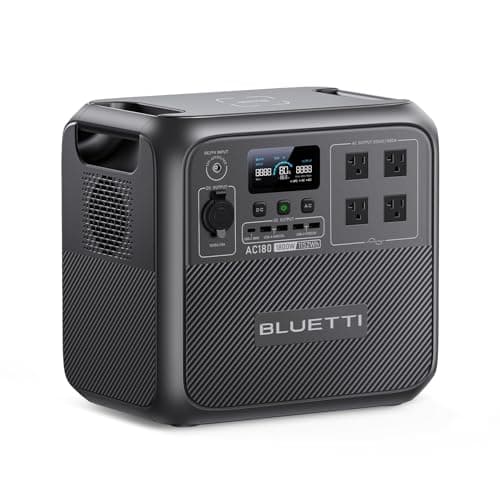 |
|---|---|---|
| Capacity | 1,002 Wh | 1,152 Wh |
| AC output | 1,000 W | 1,800 W |
| Surge | 2,000 W | 2,700 W |
| Chemistry | NMC | LiFePO4 |
| Weight | 22 lb | 35.3 lb |
| Solar input | 163 W | 500 W |
| Warranty | 3 yr | 5 yr |
| Check Price on Amazon | Check Price at BLUETTICode AFF5OFF at checkout |
Lineup Philosophy
Jackery built its reputation on making solar power feel like a consumer product: orange-and-black boxes with a big handle, a glance-readable screen, and almost nothing to configure. The lineup runs from grab-and-go units like the Explorer 300 up through home-scale HomePower systems, but the design DNA stays the same — fewer ports, lower weight, less to think about. The Explorer 1000 is the archetype: 1,002Wh and a 1,000W inverter at just 22 pounds, lighter than nearly anything in its class.
BLUETTI approaches the same market like an engineering company. Its stations are heavier and busier-looking, but the spec sheets consistently punch above their class: the AC180 packs 1,152Wh and an 1,800W inverter into the same price bracket where Jackery offers 1,000W. Across the range, BLUETTI leans into LiFePO4 chemistry, higher solar input ceilings, more AC outlets, and expandable or feature-dense designs.
Neither philosophy is wrong. Jackery is the brand you hand to a relative who wants backup power with zero learning curve. BLUETTI is the brand for people who read spec tables and want maximum capability per dollar — and accept some extra weight to get it.
Battery Chemistry and Longevity
This is the most consequential difference between the two units we are comparing. The BLUETTI AC180 uses LiFePO4 (lithium iron phosphate) cells rated for roughly 3,500 cycles before meaningful capacity fade — cycle it daily and it is still a decade-class tool. The Jackery Explorer 1000 we are anchoring on uses older NMC chemistry rated around 500 full cycles, which is fine for occasional weekend duty but ages quickly under regular solar cycling.
To be fair to Jackery, the brand has been migrating its newer releases to LiFePO4 — so check the chemistry line on whichever specific model you are buying. But plenty of NMC-based Jackery inventory is still on shelves, often at tempting discounts, and the chemistry difference is exactly the kind of fine print that decides whether a station is a two-year purchase or a ten-year one.
LiFePO4 also tolerates heat better and is the more forgiving chemistry from a safety standpoint, which matters for a battery that lives in a vehicle or a closet. If you plan to use a power station regularly — and especially if you plan to recharge it from solar most days — the chemistry column should weigh more than almost any other spec.
Charging and Solar Input
BLUETTI wins the refill race, and it is not close in this matchup. The AC180 accepts up to 500W of solar input and recharges from the wall to 80% in about 45 minutes. That solar ceiling means a couple of 200W panels can genuinely refill the station in 2–3 hours of decent sun, which is the difference between solar as a real power source and solar as a slow top-up.
The Explorer 1000 caps solar input at 163W. In practice that means most of a perfect sunny day to refill from empty, even with plenty of panel on hand. Its wall charging is similarly leisurely by current standards. For weekend campers who recharge at home between trips, this matters less than the spec sheet suggests — but for boondockers, off-grid workers, or anyone riding out a multi-day outage, input speed is the spec you bump into constantly.
One practical note that partially redeems Jackery: both brands charge happily from third-party panels with the right adapters, so you are not locked into either ecosystem for solar. But the input ceiling is hardware, and no panel purchase can raise it later. Buy more input headroom than you think you need.
App, Warranty, and Support
BLUETTI backs the AC180 with a 5-year warranty; the Explorer 1000 carries 3 years. That two-year gap roughly tracks the chemistry difference — LiFePO4 makers can afford longer coverage because the cells last longer — and we treat warranty length as an honest signal of a manufacturer’s own confidence.
On software, BLUETTI’s app gives you remote monitoring, charge-speed control, and settings like charge limits that genuinely extend battery life. Jackery’s newer units have app control too, but the unit we are comparing here is from the brand’s simpler era: what you see on the screen is what you get. Some buyers will consider that a feature — there is real appeal in a station with no firmware personality.
Both companies are established enough that support is a known quantity: parts, responsive service desks, and a long track record of honoring warranties in the US market. Jackery has the longer consumer-brand history and a particularly strong record on build reliability; BLUETTI’s support reputation has matured solidly as the brand has grown. We would not steer anyone away from either company on support grounds — the differences that matter here are warranty length and app capability, and both favor BLUETTI.
Value for Money
Spec-per-dollar, BLUETTI wins this matchup decisively. The AC180 routinely sells at or below the Explorer 1000’s street price while offering 15% more capacity, 80% more inverter output, three times the solar input, LiFePO4 longevity, and two extra years of warranty. If you score the two units on a spreadsheet, it is a rout.
But spreadsheets do not carry the station to the campsite. The Explorer 1000 is 13 pounds lighter — 22 pounds versus 35.3 — and that gap is the entire reason the Jackery still earns a recommendation from us. For an angler walking gear to a remote bank, a tailgater, or anyone with a bad back, the lightest competent station in the class has a value no spec table captures.
Our honest framing: think about cost per year of expected service. Cycled regularly, the LiFePO4 BLUETTI plausibly delivers four to six times the working life of an NMC Jackery at similar money, which makes it one of the easiest value calls we make. Cycled ten times a year, both will age out by calendar rather than cycles, and the Jackery’s portability premium starts looking entirely rational.
The bottom line
Buy the Jackery Explorer 1000 if…
Buy Jackery if portability and simplicity top your list. The Explorer 1000 is dramatically lighter than its rivals, the interface is effortless, and the brand’s reliability record is excellent. It is the right choice for occasional campers, tailgaters, and anyone who wants backup power that a non-technical family member can operate without a manual — just confirm the specific model you buy has LiFePO4 cells if you plan to cycle it often.
Check Price on AmazonBuy the BLUETTI AC180 if…
Buy BLUETTI if you care about specs, longevity, and value. The AC180 gives you more capacity, an inverter big enough for kettles and microwaves, 500W of solar input, LiFePO4 cells rated for a decade of regular cycling, and a 5-year warranty — usually for the same money or less. It is our pick for home backup, regular off-grid use, van setups, and anyone who recharges from solar more than a few times a year.
Check Price at BLUETTICode AFF5OFF at checkoutFrequently asked questions
Is Jackery or BLUETTI more reliable?
Both brands have strong reliability records and established US support. Jackery has the longer consumer track record and famously simple, durable hardware. BLUETTI’s LiFePO4-first lineup tends to age better under heavy cycling because the chemistry itself lasts 4–6x longer. For occasional use, call it a tie; for daily cycling, BLUETTI’s chemistry advantage wins out.
Do Jackery and BLUETTI power stations work with each other’s solar panels?
Generally yes, with the right adapter. Both brands’ stations accept third-party panels as long as the panel’s voltage falls within the station’s input range and you use a compatible connector (commonly MC4 to XT60 or DC8020). Check the input voltage spec before mixing brands, but you are not locked into either ecosystem.
Which brand is better for home backup power?
BLUETTI, in most cases. Higher inverter output, faster recharging, bigger solar input ceilings, and LiFePO4 longevity all matter more than weight when the unit lives in a closet. Jackery’s larger HomePower systems are credible home-backup options too, but in the popular 1–2kWh classes BLUETTI typically gives you more outage capability per dollar.
Is the Jackery Explorer 1000 outdated in 2026?
The original NMC-based Explorer 1000 is an older design — its 500-cycle chemistry and 163W solar cap trail the current class. It remains a fine occasional-use station, especially discounted, and it is still one of the lightest 1kWh units available. Jackery’s newer releases address most of these gaps, so compare the exact model and chemistry before buying.