As an Amazon Associate we earn from qualifying purchases
RoverSolar

The Best Solar Generators of 2026 (Station + Panel Kits)

Updated June 2026

Dominick DePaola

Dominick DePaola

Off-grid power editor at RoverSolar

A "solar generator" is just a power station bundled with a folding panel, and the bundle matters: a great station with an undersized panel is a battery that goes flat by day two. We judged these kits on whether the included panel can realistically refill the battery in a day of decent sun, on battery chemistry (we strongly prefer LiFePO4 and its 3,000+ cycle life), on inverter output and surge handling, and on warranty — five years is the bar the good brands now clear.

Set expectations on solar honestly: a 200W panel delivers 200W only in strong, direct, well-aimed sun. Plan on 60–75% of the rating across a real day, less with clouds or bad angles. That math is why we flag the kits whose panels are too small for their batteries.

We bought or borrowed every kit here and ran them on real trips and real outages. Links are affiliate links; rankings are ours alone.

Best for Home Backup
Jackery HomePower 3000 + 2×200W Panels

Jackery

Jackery HomePower 3000 + 2×200W Panels

3,072Wh3,600W AC+400W solar
9.0

Whole-circuits backup in one box: 3,072Wh of LiFePO4, a 3,600W inverter (7,200W surge), and 400W of folding solar to keep it topped through an outage.

Check Price at JackeryCode POWER3000 at checkout
Best Expandable
OUPES Mega 1 + 240W Panel

OUPES

OUPES Mega 1 + 240W Panel

1,024Wh2,000W AC+240W solar
8.0

The expandable underdog: 1,024Wh LiFePO4 with a 2,000W inverter, sub-20ms UPS switchover, and capacity that grows to 5,120Wh with extra batteries.

Best Starter Kit
Anker SOLIX C300 + 60W Panel

Anker

Anker SOLIX C300 + 60W Panel

288Wh300W AC+60W solar
8.3

A tidy starter kit: 288Wh LiFePO4 with 140W two-way USB-C and a packable 60W panel — perfect for tailgates and weekend sites.

Cheapest Usable Kit
ZeroKor 300W Solar Generator Kit

ZeroKor

ZeroKor 300W Solar Generator Kit

280Wh300W AC+60W solar
6.8

The cheapest complete station-plus-panel kit that we consider usable — 280Wh with a 60W folding panel for emergency kits and gift budgets.

Why each pick earns its spot

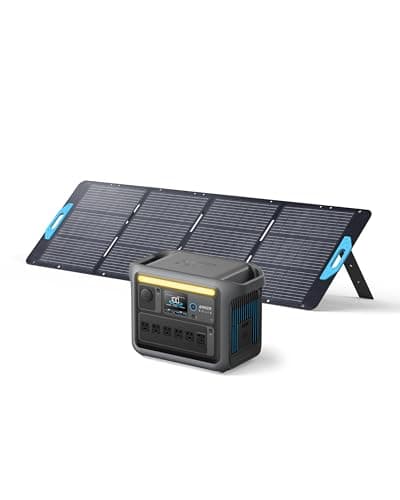
1. Anker SOLIX C1000 + 200W Panel · Top Pick

This is the bundle we recommend when someone says "just tell me what to buy." The station brings 1,056Wh of LiFePO4 and an 1,800W inverter with 2,400W SurgePad for compressor and motor startups, and the included 200W panel is genuinely efficient — in good sun it refills the battery in roughly six to seven hours of harvest. Crucially, the 600W solar input ceiling means the bundled panel isn't the end of the road: add more panels later and triple your charge rate without replacing anything. The 5-year warranty and 28.4 lb station weight round it out. The trade-off versus the Jackery HomePower kit below is raw capacity — this won't carry a whole outage weekend — but for camping, tailgates, and single-room backup it's the best balance of price, panel, and station we've tested. The panel's kickstand legs are its one weak point in wind; brace them.

2. Jackery HomePower 3000 + 2×200W Panels · Best for Home Backup

When the grid goes down for days rather than hours, capacity is everything, and this kit brings 3,072Wh of LiFePO4 with a 3,600W inverter and a huge 7,200W surge — enough to run a fridge, sump pump, and lights at the same time without drama. The bundled 400W of folding solar is what makes it outage-self-sufficient: in decent sun it harvests enough daily to keep essential loads running indefinitely. The trade-offs are exactly what you'd guess. At 60 lb the station is wheeled-cart territory, not a campsite grab-and-go, and the price reflects three times the capacity of our top pick. Buy it if backup is the primary mission and camping is occasional; if those priorities are reversed, the Anker C1000 kit does the camping job at less than half the weight.

3. OUPES Mega 1 + 240W Panel · Best Expandable

The Mega 1 is the kit for people who want to start at 1kWh and grow. The base unit is 1,024Wh of LiFePO4 with a 2,000W inverter and a class-leading 4,000W surge, and expansion batteries take the system to 5,120Wh — a capability that's rare under $1,500 and that neither the Anker nor Jackery kits here can match. The sub-20ms UPS switchover is the other standout: plug a desktop PC or CPAP into it and an outage never registers. The included 240W panel is the largest bundled panel in this roundup short of the Jackery kit. The honest trade-offs: OUPES is a smaller brand with a thinner support network than Jackery, Anker, or BLUETTI, and the app is clunky. If brand support matters more to you than expandability, stay with our top pick.

4. Anker SOLIX C300 + 60W Panel · Best Starter Kit

If you're not sure solar camping is your thing yet, this is the low-commitment way to find out without buying junk. The C300 station packs 288Wh of LiFePO4 — real 3,000-cycle chemistry with a 5-year warranty, unheard of at this price a few years ago — plus a 140W bidirectional USB-C port that fast-charges the unit itself or a laptop. At 9.3 lb it's a true one-hand carry. The weak link is the bundled 60W panel: against 288Wh of battery it needs most of a sunny day to refill from empty, and cloudy weather stretches that further. That's the trade-off versus the C1000 kit — a fifth the panel, a quarter the battery, a fraction of the price. For phones, lights, laptops, and a weekend campsite, it's exactly enough.

5. ZeroKor 300W Solar Generator Kit · Cheapest Usable Kit

We've tested cheaper kits than this ZeroKor bundle; this is the cheapest one we'd actually hand to a family member. The 280Wh station puts out a true pure sine wave — rare at impulse-buy prices, and it matters for CPAPs and laptop bricks — and the 60W folding panel makes it a complete, self-recharging emergency box. Be clear-eyed about what you're giving up versus the Anker C300 kit: Li-ion cells instead of LiFePO4 (think hundreds of cycles, not thousands), a 1-year instead of 5-year warranty, a single AC outlet, and unknown long-term durability from a young brand. That's the wrong trade for a weekly camper. It's the right trade for a hurricane closet, a gift budget, or a glovebox backup that gets used a few times a year.

Head-to-head specs

Specification comparison
Spec
Anker SOLIX C1000 + 200W Panel
Jackery HomePower 3000 + 2×200W Panels
OUPES Mega 1 + 240W Panel
Anker SOLIX C300 + 60W Panel
Capacity1,056 Wh3,072 Wh1,024 Wh288 Wh
AC output1,800 W3,600 W2,000 W300 W
Surge2,400 W7,200 W4,000 W600 W
ChemistryLiFePO4LiFePO4LiFePO4LiFePO4
Weight28.4 lb60 lb9.3 lb
Solar input600 W
Panel200 W400 W240 W60 W
Warranty5 yr5 yr5 yr5 yr
Check Price on AmazonCheck Price at JackeryCode POWER3000 at checkoutCheck Price on AmazonCheck Price on Amazon

Frequently asked questions

What size solar generator do I need for home backup?

Add up your essential loads. A fridge runs at 50–60W but cycles, averaging roughly 1–1.5kWh per day; add lights, phones, a router, and a fan and most households need 2–3kWh daily. A 3kWh kit like the Jackery HomePower 3000 covers a full day per charge, and its 400W of panels can replace most of that daily in good sun. A 1kWh kit handles a fridge plus small loads for half a day to a day.

How long does a solar panel take to recharge a power station?

Divide battery capacity by realistic harvest, not the panel's sticker rating. A 200W panel typically delivers 120–150W averaged across good sun, so a 1,000Wh station refills in roughly 6–8 hours of strong sunlight — about one full summer day. Clouds, haze, bad aim, and partial shade all cut that meaningfully. This is why we flag kits whose panels are small relative to their batteries.

Can a solar generator run an air conditioner?

Small ones, sometimes. A window unit or RV AC draws 500–1,500W running with a large startup surge, so you need both a strong inverter and serious capacity — the HomePower 3000's 3,600W output and 7,200W surge qualify, but even 3kWh only buys a few hours of runtime. Central air is out of reach for any portable kit. For cooling off-grid, a 40–60W 12V fan is the realistic answer.

Are solar generators worth it compared to gas generators?

They solve different problems. Gas generators deliver more sustained watts per dollar but need fuel, maintenance, and outdoor placement, and they're loud. Solar generators are silent, run safely indoors, need zero fuel, and recharge themselves in sun — but cost more per watt-hour up front. For outages under a few days and all camping use, we'd take solar. For week-long outages running heavy loads, gas still wins on pure economics.

Do solar generators work on cloudy days?

Yes, but at a fraction of rated output — expect roughly 10–25% of the panel's rating under solid overcast, and around half in light haze. A 200W panel might harvest only 20–50W under heavy cloud, which is why we recommend sizing panels generously and topping the battery off whenever sun appears rather than waiting until it's empty. Cold clear days, by contrast, are excellent: panels actually run more efficiently cool.