
Anker
Anker SOLIX C1000 Gen 2
1,024Wh2,000W ACLiFePO4
8.9Anker’s refined 1kWh station: 1,024Wh LiFePO4 pushing 2,000W (3,000W peak) with ultra-fast recharging and a quieter thermal design.
Updated June 2026

Dominick DePaola
Off-grid power editor at RoverSolar
We've hauled power stations to campsites, run them through power outages, and drained them with everything from CPAP machines to circular saws. This list is what survived. Our ranking weighs four things: battery chemistry (LiFePO4 cells last 3,000–3,500 cycles, while older NMC and Li-ion packs fade after roughly 500), real-world inverter output, weight you'll actually carry, and warranty length, because a power station is a five-to-ten-year purchase.
A quick expectation check: no 1kWh station runs a whole house, and no 300Wh unit runs a space heater. The right station is the one matched to your loads. We note exactly what each pick can and can't run, so read the why on each before you buy on the award name alone.
Every unit here was either purchased or borrowed for testing, and the Amazon links are affiliate links — that's how we keep the lights on, but it never changes the ranking.
Anker
Anker’s refined 1kWh station: 1,024Wh LiFePO4 pushing 2,000W (3,000W peak) with ultra-fast recharging and a quieter thermal design.

Jackery
The power station that defined the 1kWh class. Still one of the lightest 1,000W units you can buy, with a dead-simple interface and a huge track record.
BLUETTI
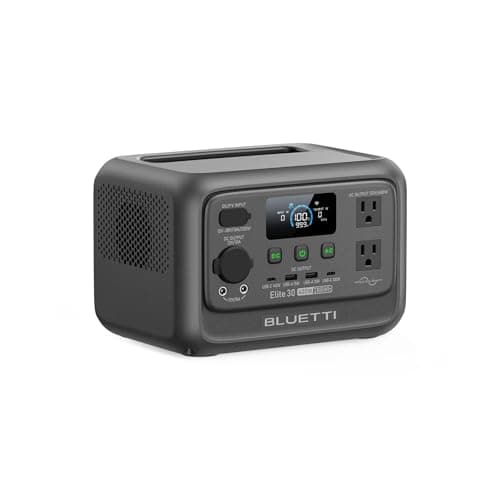
The budget LiFePO4 entry point: 288Wh with a surprisingly capable 600W inverter (1,500W lifting mode) in a sub-10-pound body.

Jackery
The grab-and-go pick: 293Wh at just over 7 pounds, enough to keep phones, cameras, and a laptop charged all weekend.

Jackery
A weekend-camping classic: 518Wh and a single 500W outlet in a lunchbox-sized package with a sturdy carry handle.
The AC180 is the station we reach for first, and it's not close. You get 1,152Wh of LiFePO4 — rated for 3,500+ cycles, so it outlives an NMC unit like the Explorer 1000 six times over — pushing a genuine 1,800W with 2,700W surge. That's enough for a microwave, a kettle, or a miter saw. Wall charging hits 80% in about 45 minutes, and the 500W solar input can refill it in one sunny day. The trade-off versus the Anker C1000 Gen 2 below is weight: at 35.3 lb it's nearly 8 lb heavier and gives up 200W of output. But it usually costs less, carries the same 5-year warranty, and the four AC outlets plus 100W USB-C cover almost any campsite or outage scenario. If you're buying one station for everything, buy this one.
The C1000 Gen 2 actually out-muscles our top pick: 2,000W continuous and 3,000W surge from a 1,024Wh LiFePO4 pack, with six AC outlets so you never hunt for a power strip. It also recharges from the wall in roughly an hour and accepts 600W of solar — 100W more input headroom than the AC180. So why is it second? It typically sells for more per watt-hour, it has slightly less capacity, and a few settings live only in the app, which annoys us in the field. At 27.6 lb it's the easier of the two to lift into a truck bed. Buy it over the AC180 if you run high-draw tools or appliances, if outlet count matters, or if you find it on sale — at equal prices this is a coin flip.
The Explorer 1000 defined this category, and there's real value in that track record: years of field use, a dead-simple interface, and at 22 lb it's lighter than nearly every 1kWh rival — 5.6 lb less than the Anker and over 13 lb less than the AC180. The honest downside is the chemistry. Its NMC cells are rated around 500 full cycles, versus 3,000+ for the LiFePO4 picks above, and the 163W solar input cap means a full solar recharge takes most of two days. We recommend it to weekend campers who use a station a few dozen times a year and prize low weight and simplicity; daily users and home-backup buyers should pay up for LiFePO4. Watch for sales — at its frequent discount prices it's a genuinely strong buy.
Most stations under $250 cut the corner that matters most — chemistry — but the Elite 30 V2 brings LiFePO4 (and a 5-year warranty) to the cheapest tier. The 288Wh capacity is honest about what it is: phones, laptops, lights, a CPAP for a night or two. The surprise is the 600W inverter with a 1,500W power-lifting mode that runs resistive loads like a kettle or hair dryer most rivals this size refuse. At 9.7 lb it's a one-hand carry, and the 100W bidirectional USB-C fast-charges both your laptop and the unit itself. The trade-off versus the Explorer 300 below is about 2.6 lb of extra weight; in exchange you get double the AC output and six times the cycle life. For a first station, this is the smart money.
At 7.1 lb, the Explorer 300 is the station you stop noticing in the truck — light enough to walk from car to picnic table without a second thought. The 293Wh pack and 300W inverter handle the realistic weekend list: phone charging all weekend, a couple of laptop refills via the 60W USB-C PD port, camera batteries, a fan. The trade-offs versus the Elite 30 V2 are real: Li-ion cells with a fraction of the cycle life, half the AC output, and a 3-year instead of 5-year warranty. We still pick it for people who fly-and-drive, paddle in, or simply won't carry ten pounds. Don't plan on fridges or heaters, and note that at 293Wh it's well over the 100Wh TSA carry-on limit — it travels by car, not by plane.
CPAP users have one question: will it run my machine all weekend? The Explorer 500's 518Wh pack answers yes for most setups. A typical CPAP with humidifier and heated hose off draws 30–60W, so you'll see roughly two nights with margin, or three-plus if you run the machine on its 12V car-port input and skip the inverter loss. It's quiet, the 13.3 lb lunchbox shape carries one-handed, and the controls are impossible to fumble at 2 a.m. The honest knocks: a single AC outlet, dated Li-ion chemistry, and a slow 100W solar input cap. The Elite 30 V2 is cheaper but its 288Wh is one night of CPAP, not two. If sleep gear is the mission, the extra capacity here is exactly what you're paying for.
| Spec | 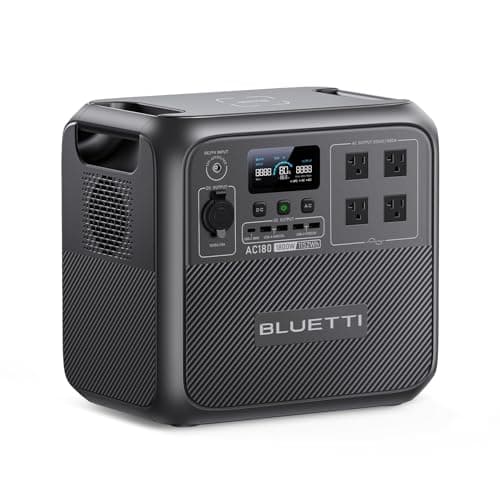 | | | |
|---|---|---|---|---|
| Capacity | 1,152 Wh | 1,024 Wh | 1,002 Wh | 288 Wh |
| AC output | 1,800 W | 2,000 W | 1,000 W | 600 W |
| Surge | 2,700 W | 3,000 W | 2,000 W | 1,500 W |
| Chemistry | LiFePO4 | LiFePO4 | NMC | LiFePO4 |
| Weight | 35.3 lb | 27.6 lb | 22 lb | 9.7 lb |
| Solar input | 500 W | 600 W | 163 W | 200 W |
| Warranty | 5 yr | 5 yr | 3 yr | 5 yr |
| Check Price at BLUETTICode AFF5OFF at checkout | Check Price on Amazon | Check Price on Amazon | Check Price at BLUETTI |
Most CPAPs draw 30–60W with the humidifier off, so budget roughly 300–500Wh per night with margin. A 518Wh unit like the Jackery Explorer 500 covers about two nights; a 288Wh unit covers one. Two tips stretch runtime: turn off the heated humidifier and hose, and run the machine from the 12V car port with a DC adapter to skip inverter losses.
Usually not. TSA allows lithium batteries up to 100Wh in carry-on without approval, and 101–160Wh only with airline approval. Every full-size power station on this list exceeds 160Wh, so none of them can fly in carry-on or checked baggage. If you travel by air, plan on a sub-100Wh USB battery bank and renting or buying gear at your destination.
For most buyers, yes. LiFePO4 cells are rated for roughly 3,000–3,500 charge cycles before dropping to 80% capacity, while the NMC and Li-ion packs in older stations fade after about 500 cycles. If you use a station weekly, that's the difference between replacing it in two or three years and keeping it for a decade. Occasional weekend users can reasonably save money on Li-ion.
A full-size fridge draws about 50–60W while running but surges to several hundred watts when the compressor kicks on, so you need an inverter with solid surge handling — the AC180's 2,700W surge or the C1000 Gen 2's 3,000W is plenty. On capacity, a 1kWh station runs a fridge roughly 12–18 hours since the compressor cycles on and off. Add solar to go longer.
Store it at around 50–80% charge in a dry place between roughly 32°F and 85°F, and top it up every three months or so. Avoid storing any lithium battery at 0% — deep discharge during long storage is one of the few ways to permanently damage a LiFePO4 pack. Most stations on this list hold their charge for months with minimal self-discharge.