Hands-On Review
Jackery Explorer 300 Review (2026): The 7 lb Workhorse
Our hands-on Jackery Explorer 300 review: 293Wh at just 7.1 lb with 60W USB-C PD — the grab-and-go pick for weekends, with honest limits on AC loads.

Dominick DePaola
Off-grid power editor at RoverSolar · June 11, 2026
Who It's For
The Explorer 300 is for people whose power needs are measured in devices, not appliances. If your weekend list is phones, a tablet, a mirrorless camera, headlamps, and a laptop, this 7.1-pound box covers all of it with weight to spare — and weight is the entire argument. It's light enough to carry in one hand alongside a camp chair, light enough to live permanently in the car, and light enough that bringing it requires no decision at all.
It suits weekend tent campers, day-trip photographers, tailgaters, and anyone assembling a car emergency kit. The 60W USB-C PD port matters more than it sounds: it charges most laptops directly over USB-C at full speed with no inverter losses, which is both faster and more efficient than using the AC outlets for the same job.
Who should skip it: anyone who needs to run AC appliances. The 300W inverter and 293Wh capacity make fridges, kettles, space heaters, and hair dryers either impossible or impractical, and CPAP users get roughly one night, not a weekend. If your needs include any of that, step up to a 1kWh-class unit — or, if you want longer battery lifespan at this size, look at the LiFePO4-based BLUETTI Elite 30 V2 or Anker SOLIX C300.
Capacity and Output in Practice
The pack holds 293Wh. Through the AC inverter at roughly 85% efficiency that's about 250Wh of usable output — and notably more when you stay on the DC side, which is where this unit lives its best life. In practice: about 20 phone charges at ~12Wh each, roughly four full laptop charges at ~60Wh via the USB-C port, and essentially unlimited headlamp, earbud, and GoPro top-ups across a weekend.
A CPAP drawing about 30W without its humidifier runs roughly eight hours — one full night, with little margin for a second. At 40W you're looking at six hours, which may not finish the night. We'd call the Explorer 300 a one-night CPAP backup, not a camping CPAP solution; for multi-night use you want a 1kWh-class station.
The 300W inverter (500W surge) defines the AC ceiling. It runs a TV, a fan, a laptop brick, or a CPAP without complaint. It will not run a kettle (1,200–1,500W), a hair dryer, or a space heater, and while a 50W 12V fridge technically runs, about five hours of compressor runtime makes it pointless. Know what this unit is — a big battery for small electronics — and it never disappoints. Ask it to be a generator and it immediately will.
Charging: Wall and Solar
Solar input caps at 90W. The arithmetic: 293Wh divided by 90W is about 3.3 hours at full panel output, but folding panels rarely sustain their rating, so a realistic full solar recharge with a 90–100W panel is around five hours of good sun — very achievable in a single day, which is better than most big stations can claim with their bundled panels. Pair it with a 100W folder and a stationary camp keeps the Explorer 300 effectively topped off indefinitely for phone-and-camera duty.
Wall charging is simple and unceremonious — plug it in, walk away, come back to a full unit well within a day. There's no fast-charge party trick here, but at this capacity there doesn't need to be; even modest input rates refill a 293Wh pack in hours, not overnight.
The quietly useful third option is the 12V car socket. Charging while you drive to the trailhead means arriving full without planning ahead, and for a unit that lives in the car as an emergency kit, that habit alone keeps it ready. One caution from experience: like all Li-ion packs, it prefers to be stored around half charge if it'll sit untouched for months — top it off before the trip, not after.
Build and Portability
At 7.1 pounds, the Explorer 300 is in a different category of portable than anything else we cover in this size class with an AC inverter aboard. It weighs less than a gallon of water. You carry it like a small cooler — one hand, no bracing, no second thoughts — and that translates into a unit that actually goes places: the beach blanket, the far campsite, the kids' soccer tournament, the back row of the car for months at a stretch.
The layout is classic Jackery: a sturdy molded handle, a clear display showing input/output watts and remaining charge, and physical buttons with no app dependency. Ports run two AC outlets, one USB-C PD at 60W, one USB-A, and a 12V car socket. Two AC outlets at this size is genuinely useful — rivals often ship one — and the 60W USB-C earns its keep daily as a laptop charger.
Build quality matches the brand's track record: tight housing, no creaks, controls that survive being tossed in a trunk. If we're nitpicking the hardware, a second USB-A port would help families, and the orange-and-black aesthetic announces itself more than some owners would like. Neither changes the bottom line: this is the best-carrying power station we've tested at any capacity that can still run an AC plug.
What We'd Change
The honest weakness is chemistry. The Explorer 300 uses Li-ion cells, which typically fade after several hundred full cycles — serviceable for occasional use, but well short of the LiFePO4 packs in the BLUETTI Elite 30 V2 and Anker SOLIX C300, which are rated for thousands of cycles. Both of those rivals also carry 5-year warranties against Jackery's 3. If you'll cycle the unit weekly — vanlife device-charging, daily off-grid work — the Jackery's weight advantage gets repaid in earlier battery fade, and we'd steer you to the LiFePO4 options.
Second, the AC ceiling. We don't fault a 293Wh unit for being small, but the Elite 30 V2 proves a sub-10-pound station can carry a 600W inverter with a 1,500W lifting mode — enough for brief kettle duty — while the Explorer 300's 300W limit shuts that door entirely. Jackery's platform is simply older here.
Third, the 90W solar cap and dated input mean recharge speed is adequate rather than impressive. And finally a small one: one USB-A port is tight for a family unit. None of this undoes the core appeal — nothing else this light does this much — but the Explorer 300 is now the legacy choice in its class, and it should be priced like one when you shop.
The Verdict
The Explorer 300 earns its 7.8 rating the same way the bigger Explorer 1000 earns its reputation: by being light, simple, and reliable in the field. At 7.1 pounds it undercuts the BLUETTI Elite 30 V2 (9.7 lb) and the Anker SOLIX C300 (9.3 lb), and for the buyer whose whole use case is keeping devices alive away from outlets, it remains the easiest unit to own — and very often the cheapest of the three.
But the class has moved. Both rivals bring LiFePO4 chemistry rated for thousands of cycles against the Jackery's several hundred, both carry 5-year warranties against 3, the BLUETTI brings a 600W inverter that embarrasses the Jackery's 300W, and the Anker counters with 140W two-way USB-C and a bundled panel. On almost every spec that isn't weight, the Explorer 300 now trails.
So our recommendation splits cleanly. Buy the Explorer 300 if minimum weight and proven simplicity top your list and you cycle it occasionally — it will not let you down. Buy the Elite 30 V2 if you want AC muscle and battery longevity at nearly the same weight, or the SOLIX C300 kit if you want solar included. The Jackery is still a good product; it's just no longer the obvious one.
How it stacks up
| Spec |  | 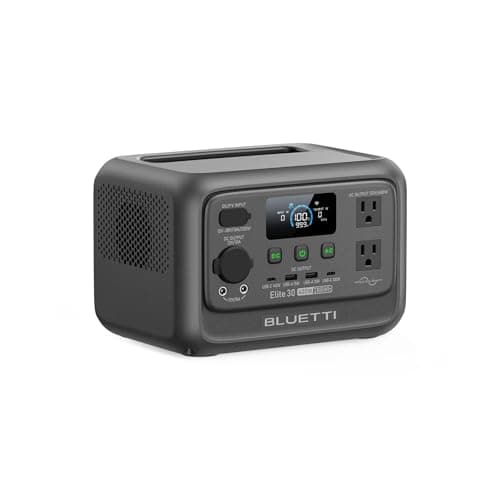 |  |
|---|---|---|---|
| Capacity | 293 Wh | 288 Wh | 288 Wh |
| AC output | 300 W | 600 W | 300 W |
| Surge | 500 W | 1,500 W | 600 W |
| Chemistry | Li-ion | LiFePO4 | LiFePO4 |
| Weight | 7.1 lb | 9.7 lb | 9.3 lb |
| Solar input | 90 W | 200 W | — |
| Panel | — | — | 60 W |
| Warranty | 3 yr | 5 yr | 5 yr |
| Check Price on Amazon | Check Price at BLUETTI | Check Price on Amazon |
Frequently asked questions
How long does the Jackery Explorer 300's battery last?
It uses Li-ion cells, which typically hold up for several hundred full charge cycles before noticeable fade — fine for weekend and occasional use. Heavy cyclers should consider LiFePO4 rivals like the BLUETTI Elite 30 V2 or Anker SOLIX C300, rated for thousands of cycles with 5-year warranties.
Will the Explorer 300 run a CPAP overnight?
One night, yes — with care. A CPAP drawing about 30W without its humidifier runs roughly eight hours on the unit's ~250Wh of usable AC output. At 40W you get about six hours, which may not cover a full night. For multi-night trips, choose a 1kWh-class station.
Can the Jackery Explorer 300 run a fridge or kettle?
No on both, practically speaking. A 1,200–1,500W kettle far exceeds the 300W inverter, and while a 50W 12V fridge runs, the pack supports only about five hours of compressor runtime. This unit is built for phones, laptops, cameras, lights, and a CPAP — not appliances.
Can I take the Explorer 300 on a plane?
No. TSA limits carry-on batteries to 100Wh, or 101–160Wh with airline approval. At 293Wh the Explorer 300 exceeds both thresholds and cannot travel on passenger flights — it has to ride in the car, which, at 7.1 pounds, it does better than anything else.
See every pick: The Best Power Stations for Camping in 2026 →