Hands-On Review
BLUETTI AC180 Review (2026): The All-Rounder to Beat
Our field-tested BLUETTI AC180 review: 1,152Wh LiFePO4, a real 1,800W inverter, 45-minute fast charging, and where the 35 lb weight starts to hurt.

Dominick DePaola
Off-grid power editor at RoverSolar · June 11, 2026
Who It's For
The AC180 is the unit we recommend when someone asks for one power station that does everything reasonably well. If you car camp a few weekends a season, want a fridge and lights covered during a home outage, and occasionally need to run a real appliance — a kettle, a microwave, a circular saw — this is the box that handles all three without forcing you into a bigger, pricier tier.
It's especially right for buyers planning to keep the unit for years. The LiFePO4 chemistry is rated for 3,500+ cycles, which works out to roughly a decade of regular use before meaningful capacity loss. That matters more than most spec-sheet numbers: the cheaper NMC units in this class fade after a few hundred cycles, and we've watched older packs lose their usefulness right when owners started depending on them.
Who should skip it: backpackers and anyone who has to carry their power more than a short distance. At 35.3 pounds it's firmly a trunk-to-table unit. And if your loads are small — phones, a laptop, a CPAP for a single night — a 300Wh-class unit like the BLUETTI Elite 30 V2 covers you for a third of the cost and a quarter of the weight.
Capacity and Output in Practice
On paper the AC180 stores 1,152Wh. Through the inverter at roughly 85% efficiency, plan on about 980Wh of usable AC power. Here's what that buys you in the field: around 80 phone charges at ~12Wh each, about 16 full laptop charges at ~60Wh, or roughly 19 hours of compressor runtime for a 12V fridge drawing 50W — which, since fridges cycle on and off, stretches to a day and a half or more of real cooling.
For CPAP users, a machine drawing 40W without its humidifier runs about 24 hours on a full charge — call it three 8-hour nights with margin to spare. That's the difference between a power station that covers a weekend and one that doesn't.
The 1,800W inverter is the other half of the story. A 1,200–1,500W kettle, which trips the limit on most 1kWh-class units, runs here without complaint, and the 2,700W surge rating absorbs the startup spike from compressors and power tools. In our testing we boiled water for coffee all weekend and never saw an overload fault. One full kettle boil costs around 100–110Wh from the pack, so figure roughly nine boils per charge if that's all you ran.
Charging: Wall and Solar
Wall charging is where the AC180 embarrasses older designs. It goes from empty to 80% in about 45 minutes — fast enough that topping up before a trip is something you do after breakfast, not the night before. That alone changes how you use the unit: forgetting to charge it stops being a crisis.
Solar input maxes at 500W, which is generous for the class. The math: 1,152Wh divided by 500W is about 2.3 hours of peak production, but panels rarely deliver their rated output, so in practice a full 500W array refills the AC180 in half a day of decent sun — and BLUETTI's claim of a full recharge in a single sunny day holds up even with weaker light in the morning and evening. With a more typical single 200W panel, expect a full day and a half.
Our advice: if you're building around solar, buy more panel than you think you need. The 500W ceiling gives you room that most rivals don't — the Jackery Explorer 1000 caps at 163W, which turns the same recharge into a multi-day affair. The Anker SOLIX C1000 Gen 2 is the one rival that out-runs it here with a 600W ceiling.
Build and Portability
Let's be direct about the trade-off: 35.3 pounds. That's 13 pounds heavier than the Jackery Explorer 1000 and nearly 8 more than the Anker SOLIX C1000 Gen 2. Loading the AC180 into a truck bed is a two-hand job, and carrying it across a campsite is something you do once, not repeatedly. The weight buys you a bigger pack and a stronger inverter, but you feel every ounce of it.
The port layout earns the space it takes: four AC outlets, a 100W USB-C PD port, four USB-A ports, a 12V car socket, and a wireless charging pad on top. In practice that means the whole family's devices charge at once without a power strip, and the wireless pad is genuinely handy for a phone at night. The display is bright and readable in daylight, showing input and output wattage at a glance.
Fit and finish are solid — no flex in the housing, firm rubber feet, a handle molded into each side. The one ergonomic note from extended use: under heavy loads the cooling fan is clearly audible. It's not a problem outdoors, but in a quiet cabin at night you'll hear it spin up when the unit is working hard.
What We'd Change
The weight is the honest cost of this design, and we'd be misleading you to wave it off. At 35.3 pounds the AC180 is the heaviest unit among its direct rivals, and there's no graceful way to carry it far. We'd happily trade a little of the housing bulk for a 30-pound version, and anyone with back trouble or a long walk from parking to campsite should weigh that word literally before buying.
The fan is our second gripe. It's well-behaved at light loads, but push the inverter — a kettle, a heater, fast wall charging — and it gets loud enough to notice. Most of the time that's irrelevant; the times it isn't are exactly the quiet moments (a sleeping tent, a powered-outage bedroom with a CPAP running) where you wish it were silent. To be fair, fast charging and a 1,800W inverter generate real heat, and we'd rather have an audible fan than throttled output. But rivals manage quieter thermal profiles, and BLUETTI could too.
Finally, a small wish rather than a flaw: at this weight, even simple luggage-style wheels or a telescoping handle would transform how the unit moves. Nobody in this class does it, and the first brand that does will win a lot of driveway loading arguments.
The Verdict
After living with the AC180 across camping trips and a couple of real outages, our position is simple: this is the default recommendation in the 1kWh class. It beats both of its closest rivals on capacity — 1,152Wh against the Anker SOLIX C1000 Gen 2's 1,024Wh and the Jackery Explorer 1000's 1,002Wh — and it matches Anker's 5-year warranty while doubling Jackery's 3-year coverage. Add 3,500+ rated cycles, a 1,800W inverter that runs real appliances, 45-minute fast charging, and a 500W solar ceiling, and there isn't a weak spot in the spec sheet that matters day to day.
The decision really comes down to two questions. First, do you need to carry it far? If yes, the Explorer 1000's 22 pounds will serve you better than the AC180's 35.3, and you'll accept its weaker chemistry and slower solar as the price. Second, do you need maximum output and the fastest recharge? The Anker pushes 2,000W and accepts 600W of solar, and it's a fine alternative if you find it cheaper.
For everyone else — which in our experience is most buyers — the AC180 is the one to get. It earns our 9.1 rating and a spot at the top of our portable power station rankings.
How it stacks up
| Spec | 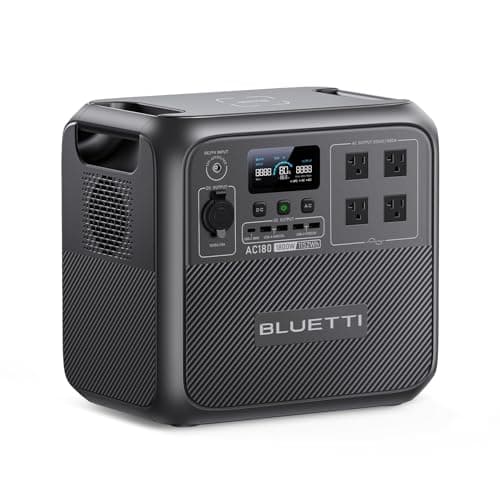 |  |  |
|---|---|---|---|
| Capacity | 1,152 Wh | 1,024 Wh | 1,002 Wh |
| AC output | 1,800 W | 2,000 W | 1,000 W |
| Surge | 2,700 W | 3,000 W | 2,000 W |
| Chemistry | LiFePO4 | LiFePO4 | NMC |
| Weight | 35.3 lb | 27.6 lb | 22 lb |
| Solar input | 500 W | 600 W | 163 W |
| Warranty | 5 yr | 5 yr | 3 yr |
| Check Price at BLUETTICode AFF5OFF at checkout | Check Price on Amazon | Check Price on Amazon |
Read the full match-up: Jackery vs BLUETTI: Which Brand Wins in 2026? →
Frequently asked questions
How long will the BLUETTI AC180's battery last?
The AC180 uses LiFePO4 cells rated for 3,500+ full charge cycles. Cycled a few times a week, that's roughly a decade of regular use before meaningful capacity loss — about six times the cycle life of NMC-based rivals like the Jackery Explorer 1000.
How many nights will the AC180 run a CPAP machine?
A CPAP drawing about 40W without its humidifier runs roughly 24 hours on the AC180's ~980Wh of usable AC output — about three 8-hour nights. Turn the humidifier off and use a DC adapter if your machine supports one, and you'll do even better.
Can the BLUETTI AC180 run a kettle or microwave?
Yes. The 1,800W continuous inverter handles a 1,200–1,500W kettle or a typical countertop microwave, and the 2,700W surge rating absorbs startup spikes. Expect a full kettle boil to use roughly 100–110Wh, so figure around nine boils on a full charge.
Can I fly with the BLUETTI AC180?
No. TSA and FAA rules cap carry-on batteries at 100Wh, with airline approval possible up to 160Wh. At 1,152Wh the AC180 is far over both limits and cannot travel on passenger aircraft — plan to drive with it or ship it ground freight.