
"Lithium battery" covers two very different chemistries, and the one you choose decides how long your investment lasts, how much it weighs, and how much you have to think about safety. We've cycled both chemistries hard — in power stations, RV banks, and bench tests — and the practical differences are bigger than the spec sheets suggest in some places and smaller in others. Here's the honest comparison, current for 2026, with the marketing fog cleared out.
First, the terms
Technically, LiFePO4 is a lithium-ion chemistry — the industry just uses sloppy shorthand. When a product says "lithium-ion" without qualification, it almost always means NMC (nickel manganese cobalt) or a close cousin, the chemistry in laptops, phones, and most EVs. LiFePO4 (lithium iron phosphate, also written LFP) swaps the nickel-cobalt cathode for iron phosphate. Same lithium ions shuttling back and forth, very different personalities.
One market note before the comparison: this fight is largely decided. Five years ago NMC dominated power stations and LiFePO4 carried a hefty premium. Today LiFePO4 is the default in nearly every new power station and drop-in solar battery, and the price gap has mostly evaporated. The question in 2026 isn't really "which should the industry use" — it's "when is NMC still the right buy, and should I avoid older NMC-based products?"
Cycle life: the headline difference
A "cycle" is one full discharge and recharge. This is where the chemistries diverge most:
- LiFePO4: 3,000–3,500 cycles to 80% of original capacity is the standard, conservative rating. Cycled daily, that's roughly a decade; cycled on weekends, it'll likely outlast your interest in the hobby.
- NMC: roughly 500–800 cycles to the same threshold. Cycled daily, that's 18 months to 2 years before noticeable fade.
Two honest caveats. First, partial cycles count proportionally — draining a battery to 50% twice equals one full cycle, so weekend users get many calendar years from either chemistry. Second, cycle ratings assume reasonable care; heat and sustained full-charge storage age NMC particularly fast. But even with generous assumptions, LiFePO4 delivers four to six times the cycle life. For a battery you cycle regularly with solar, that difference dominates everything else.
Safety: meaningful, not hysterical
NMC's nickel-cobalt cathode releases oxygen when it overheats, which can feed a self-accelerating fire — thermal runaway. That's why damaged phone batteries make the news. LiFePO4's iron-phosphate cathode holds its oxygen far more tenaciously; the chemistry is dramatically harder to ignite even when punctured or overcharged, and it tolerates heat abuse much better.
We'll keep this proportionate: quality NMC products with good battery management systems are safe — you're surrounded by NMC cells all day without incident. But for a battery that lives inside an RV, a bedroom closet, or your house as backup power, LiFePO4's wider safety margin is genuinely worth something, and it's part of why the industry moved.
Weight and energy density: NMC's remaining advantage
NMC stores roughly 30–50% more energy per pound. That's why drones, phones, and long-range EVs still use nickel-rich chemistries, and it shows up clearly in power stations: the NMC-based Jackery Explorer 1000 packs 1,002Wh into 22 pounds, while the LiFePO4 BLUETTI AC180 needs 35 pounds for 1,152Wh. Gram for gram, NMC wins and it isn't close.
Whether that matters depends entirely on how often the battery moves. Bolted into an RV bay or sitting in a garage: irrelevant. Carried from trunk to campsite a few times a year: mildly annoying. Hauled regularly, flown on a drone, or carried up trails: decisive.
Cold weather and temperature behavior
Both chemistries lose capacity in the cold, but the critical limit is the same for both: charging below freezing damages lithium cells through metallic lithium plating on the anode. Any quality battery should have low-temperature charge protection in its BMS; better LiFePO4 batteries now include self-heating so they can accept solar charge on freezing mornings. Discharging in the cold is fine for both, just with temporarily reduced capacity.
On the hot side, LiFePO4 clearly wins: it ages more slowly in heat and tolerates the inside of a summer vehicle far better. If your battery lives in a van in Arizona, this alone justifies the chemistry.
Depth of discharge and usable capacity
LiFePO4 tolerates deep cycling gracefully — using 80–90% of rated capacity routinely is within spec, and the voltage stays remarkably flat until nearly empty, so inverters run happily to the bottom. NMC prefers shallower cycling to hit even its modest cycle rating; many manufacturers quietly assume you'll average well under full discharge. Practical upshot: a 1,000Wh LiFePO4 battery gives you more usable, repeatable energy than a 1,000Wh NMC battery, narrowing NMC's density advantage in real life.
Cost: the math flipped
The old framing — "LiFePO4 costs more upfront, less per cycle" — is half-obsolete. Iron and phosphate are cheap and cobalt is not, so at the cell level LFP is now often the cheaper chemistry, which is exactly why budget power stations switched. Where you still see NMC in 2026, it's usually either a weight-critical product or an older design being sold down at a discount.
The per-cycle math remains a landslide. Run the numbers on any pair of comparable units: a LiFePO4 battery delivering 3,000 cycles costs roughly a third as much per stored kilowatt-hour over its life as an NMC equivalent delivering 700 cycles — even when the NMC unit is meaningfully cheaper upfront — and the NMC unit needs replacing years sooner on top of it. The only buyers for whom this math doesn't apply are people who cycle their battery a handful of times a year, where calendar aging retires both chemistries before cycle wear does.
Head-to-head summary
| Factor | LiFePO4 | Lithium-ion (NMC) | |---|---|---| | Cycle life | 3,000–3,500 | ~500–800 | | Usable depth of discharge | 80–90% routinely | Shallower preferred | | Safety margin | Excellent | Good with quality BMS | | Weight per Wh | Heavier | 30–50% lighter | | Heat tolerance | Very good | Ages quickly in heat | | Upfront cost (2026) | At or near parity | Sometimes cheaper on clearance | | Cost per cycle | Far lower | Far higher |
What we'd buy, by use case
Stationary or vehicle solar — RV, van, cabin, home backup: LiFePO4, no hesitation. Weight doesn't matter when it's bolted down, and cycle life and heat tolerance matter enormously. A modern 280Ah LiFePO4 drop-in is the backbone of most serious 12V builds:

ECO-WORTHY
ECO-WORTHY 12V 280Ah LiFePO4 Battery
3,584Wh of storage with Bluetooth monitoring and low-temp charge cutoff — the affordable backbone for an RV or cabin battery bank.
Power stations you'll use regularly: LiFePO4. If a station will see weekly use — solar charging, home backup duty, work off the grid — the chemistry difference is the difference between a ten-year tool and a two-year one. Our favorite all-rounder is LiFePO4 for exactly this reason:
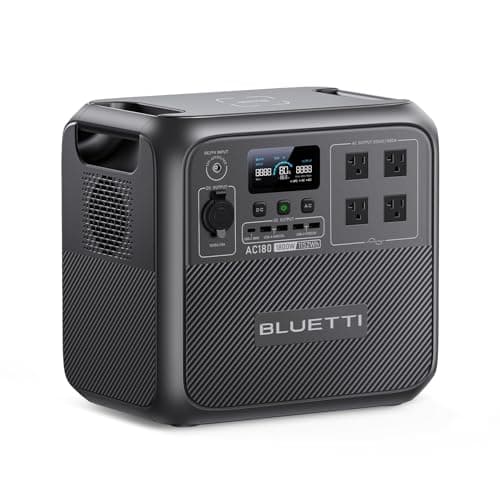
BLUETTI
BLUETTI AC180
Our favorite all-rounder: 1,152Wh of LiFePO4, a real 1,800W inverter, and fast wall charging at a price that routinely undercuts the big names.
Weight-critical gear: NMC still earns its place. Backpacking battery banks, drones, and ultralight stations carried far from the car are the legitimate NMC use cases. An NMC power station at a steep discount can also be rational for someone who'll cycle it ten times a year — just buy it knowing what you're getting.
Buying used or clearance: check the chemistry. Plenty of older NMC-based stations are being cleared out at tempting prices as brands refresh lineups with LFP. The discount is real, but so is the shorter remaining life — we'd want at least 30–40% off the equivalent LiFePO4 model before considering it.
Three spec-sheet traps to avoid
- "Lithium" with no chemistry stated. Reputable brands brag about LiFePO4. Silence on chemistry usually means NMC or worse; ask before buying.
- Cycle ratings without a capacity threshold. "6,000 cycles" sometimes means cycles to 60% capacity at gentle discharge rates. Look for ratings "to 80% capacity" — that's the comparable number, and for LFP it's typically 3,000–3,500.
- No mention of low-temperature protection. Any battery that will see freezing weather needs a BMS charge cutoff below ~32°F, ideally with self-heating. Its absence marks a corner-cut product.
Getting the most life out of either chemistry
Whichever chemistry you own, a few habits add years. These are the ones with real payoff, in rough order of importance:
- Avoid storing at 100% charge. Sitting full is the single biggest avoidable ager for both chemistries, and it hits NMC hardest. For storage longer than a few weeks, park the battery at 50–60% in a cool spot and top it up every few months. Many power stations now offer a charge-limit setting (80–85%) — turn it on for daily-driver units and charge to full only before trips.
- Keep it cool. Heat accelerates every degradation mechanism. A battery living in a 120°F vehicle interior ages several times faster than one at room temperature. Shade, ventilation, and insulation from engine heat are free lifespan.
- Respect the freezing rule. Never charge below 32°F unless the battery has self-heating or the BMS provably blocks it. Discharging in the cold is fine; charging is what plates lithium and causes permanent damage.
- Don't fear deep cycling LiFePO4. Routine 80–90% discharge is within spec — that's what you paid for. With NMC, shallower habits genuinely extend life.
- Charge at sane rates. Fast charging is fine occasionally, but day-in-day-out charging at gentler rates (0.5C or less — half the battery's capacity in amps) runs cooler and ages slower. Solar charging is naturally gentle, which is part of why solar-cycled LiFePO4 banks routinely outlive their ratings.
None of this requires babying. The honest summary: keep it cool, don't store it full, don't charge it frozen, and a LiFePO4 bank becomes a buy-once purchase.
What about sodium-ion and other chemistries?
You'll start seeing sodium-ion batteries in power stations and 12V formats — they charge in extreme cold, tolerate abuse well, and use cheap, abundant materials. The trade-off today is energy density meaningfully below even LiFePO4, so products run bigger and heavier per watt-hour. We think sodium is genuinely promising for stationary and cold-climate use, but in 2026 it's an early-adopter choice with a thin track record; for most buyers LiFePO4 remains the sensible default. Meanwhile NCA (the chemistry in many EVs) and other nickel-rich variants behave like NMC for our purposes: energy-dense, shorter-cycled, best where weight rules. If a spec sheet names a chemistry you don't recognize, the two questions that cut through it are the same as always: cycles to 80% capacity, and behavior below freezing.
The bottom line
For anything connected to solar that doesn't get carried on your back, LiFePO4 is the answer in 2026 — more cycles, more usable capacity, a wider safety margin, and pricing that no longer punishes you for choosing well. NMC survives where engineering genuinely demands its lighter weight. If you remember one sentence: buy the chemistry for how the battery will live, and when in doubt, buy iron.
Where to go next
Nearly every pick in our best portable power stations is LiFePO4 now — see how the cycle-life math shapes our rankings — and our portable power station buying guide covers the rest of the spec sheet beyond chemistry.