Hands-On Review
BLUETTI Elite 30 V2 Review (2026): Small but Mighty
Our tested BLUETTI Elite 30 V2 review: 288Wh LiFePO4 with a 600W inverter and 1,500W lifting mode under 10 lb — the budget station that punches up.

Dominick DePaola
Off-grid power editor at RoverSolar · June 11, 2026
Who It's For
The Elite 30 V2 is for the buyer who wants the cheapest entry into LiFePO4 power without accepting toy-grade output. Most 300Wh-class stations cap their inverters at 300W; this one delivers 600W continuous and a power-lifting mode that runs 1,500W resistive loads — meaning a travel kettle or small cooker is briefly on the menu, something neither the Jackery Explorer 300 nor the Anker SOLIX C300 can attempt. If your camping style includes hot coffee on AC power and your budget says small station, this is the only unit in the class that says yes.
It also suits the longevity-minded. LiFePO4 cells rated for thousands of cycles and a 5-year warranty make it a station you cycle freely — daily desk backup, weekly camping, constant van duty — without the battery anxiety that Li-ion units like the Explorer 300 earn. At 9.7 pounds it remains a true one-hand carry.
Who should look elsewhere: anyone planning sustained appliance use, because a 288Wh pack runs even a 600W load for well under half an hour. And buyers who want a complete solar bundle should compare the Anker SOLIX C300 kit, which includes a 60W panel — the BLUETTI ships bare, though its 200W solar input ceiling embarrasses both rivals once you add your own panel.
Capacity and Output in Practice
Start with the honest arithmetic. The Elite 30 V2 stores 288Wh; through the inverter at roughly 85% efficiency, that's about 245Wh of usable AC power. In device terms: around 20 phone charges at ~12Wh each, roughly four laptop charges at ~60Wh (use the 100W USB-C port for the most efficient path), and a weekend of lights, cameras, and small electronics with margin.
A CPAP drawing about 30W without its humidifier runs roughly eight hours — one solid night. A 50W 12V fridge gets about five hours of compressor runtime, which is a lunch-cooler errand, not a camping plan. So far, standard small-station math.
The inverter is where this unit breaks from the class. At 600W continuous it runs blenders, projectors, and most small kitchen gadgets that trip 300W rivals instantly. The 1,500W power-lifting mode then handles resistive heating loads — kettles, simple cookers — by managing voltage rather than refusing the load. Be clear-eyed about duration: at 1,500W, the entire usable pack is roughly ten minutes of runtime, which is exactly one kettle boil or two with discipline. That's not a flaw; it's the physics of 288Wh. The point is that the boil happens at all — morning coffee from a sub-10-pound box is this product's signature move.
Charging: Wall and Solar
Solar input is the spec that quietly separates the Elite 30 V2 from its size class: it accepts up to 200W. The math is delightful at this capacity — 288Wh divided by 200W is under an hour and a half at full panel output, so even with real-world panel derating, a 200W folder refills this station in about two hours of good sun. The Jackery Explorer 300 caps at 90W and the Anker SOLIX C300 ships with a 60W panel; neither can touch that refill rate. For a stationary camp, a properly sized panel makes this unit effectively self-sustaining: drain it on coffee and devices in the morning, full again by early afternoon.
Note that BLUETTI ships no panel in the box — you're buying your own, which is a cost to budget but also a freedom: any MC4-compatible folder in the 100–200W range works, and we'd size toward 200W to use the headroom.
The USB-C port works both directions at 100W, so a laptop-class GaN charger refills the station at a brisk rate — handy for pre-trip top-ups from the same charger that feeds your other gear — and wall charging completes in a few hours without ceremony. Between wall, car, generous solar, and USB-C, this is the most flexible charger in the small class.
Build and Portability
At 9.7 pounds the Elite 30 V2 is the heaviest of the three small stations we compare it against, but the spread — 7.1 to 9.7 pounds — is academic in use. All three are one-hand carries; this one simply carries a bigger inverter for its extra ounces. The body is compact and dense, with BLUETTI's typical sturdy housing, a practical handle, and a display that reports input and output wattage clearly enough to aim a solar panel by.
Ports cover the modern essentials: two AC outlets, a 100W USB-C that works both directions, two USB-A ports, and a 12V car socket. The two-way USB-C is the standout — one cable both charges the station and fast-charges a laptop from it. Against the Anker SOLIX C300's dual 140W USB-C array the BLUETTI gives up some USB muscle, and against both rivals it offers a port selection that's adequate rather than generous. The AC side is its turf; the USB side is merely fine.
One build note worth knowing before purchase: some early units shipped without app support, so if remote monitoring and firmware control matter to you, confirm the revision you're buying. The hardware controls cover everything essential — this is a station you can run entirely from its buttons — but in 2026 an app gap is worth flagging, and we do.
What We'd Change
First, the capacity-to-muscle mismatch deserves plain language. BLUETTI gave this unit an inverter that writes checks the 288Wh pack can't cash for long: at 600W the battery lasts well under half an hour, and at the 1,500W lifting maximum you get roughly ten minutes. We love that the capability exists — it's the product's defining feature — but buyers regularly overestimate what it means. This is burst power for a kettle boil or a blender run, and anyone imagining sustained cooking or heating will drain it before the second cup. An Elite-series sibling with double the capacity behind the same inverter would be the perfect product; this one is the clever compromise.
Second, the app situation. Some early units shipped with no app support at all, which in 2026 is a genuine gap — not because buttons don't suffice, but because firmware updates and state-of-charge visibility from inside a tent are table stakes now. Check your revision before buying and assume button-only operation as the floor.
Third, small wishes: a second USB-A port is tight for families, and we'd trade a few dollars of margin for a basic MC4 solar cable in the box, since the excellent 200W solar ceiling is exactly the feature a first-time buyer is least equipped to wire up on their own.
The Verdict
The Elite 30 V2 earns its 8.2 rating by refusing to accept its size class's limits. Among small stations it wins where winning matters: a 600W inverter that doubles both rivals' output, a 1,500W lifting mode neither can answer, LiFePO4 cells rated for thousands of cycles, a 5-year warranty that doubles Jackery's coverage, and a 200W solar ceiling that refills it faster than anything near its price. That's a remarkable spec sheet for the cheapest tier of serious power station.
The comparisons sort themselves by priority. Choose the Jackery Explorer 300 if minimum weight and maximum simplicity rule — it's 2.6 pounds lighter and proven — but accept Li-ion cycle life and a 300W ceiling. Choose the Anker SOLIX C300 kit if you want a bundled panel and best-in-class 140W USB-C for a laptop-centric kit. Choose the Elite 30 V2 if you want the most capable electrical machine of the three: the one that boils water, survives a decade of cycling, and drinks from a 200W panel.
Our bottom line: this is the small station we recommend to people who think of power in watts, not just watt-hours. Just internalize the one rule it lives by — big power, small tank — and the Elite 30 V2 will outperform its price for years.
How it stacks up
| Spec | 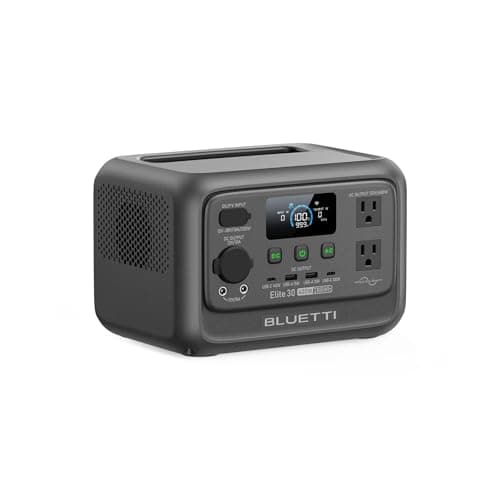 |  |  |
|---|---|---|---|
| Capacity | 288 Wh | 293 Wh | 288 Wh |
| AC output | 600 W | 300 W | 300 W |
| Surge | 1,500 W | 500 W | 600 W |
| Chemistry | LiFePO4 | Li-ion | LiFePO4 |
| Weight | 9.7 lb | 7.1 lb | 9.3 lb |
| Solar input | 200 W | 90 W | — |
| Panel | — | — | 60 W |
| Warranty | 5 yr | 3 yr | 5 yr |
| Check Price at BLUETTI | Check Price on Amazon | Check Price on Amazon |
Frequently asked questions
How long does the BLUETTI Elite 30 V2's battery last?
It uses LiFePO4 cells rated for thousands of full charge cycles — roughly a decade of regular use — and BLUETTI backs it with a 5-year warranty. That's the long-life chemistry, far outlasting Li-ion small stations like the Jackery Explorer 300.
Will the Elite 30 V2 run a CPAP overnight?
Yes, for one night. A CPAP drawing about 30W without its humidifier runs roughly eight hours on the unit's ~245Wh of usable AC output. With a 200W solar panel it can refill in about two hours of good sun the next day, making multi-night trips workable in sunny weather.
Can the Elite 30 V2 really run a kettle?
Briefly, yes — and that's unique in its class. Power-lifting mode handles 1,500W resistive loads like kettles, but at that draw the 288Wh pack supports only about ten minutes of runtime. Plan on one boil per session, not sustained cooking, and it delivers.
Can I take the Elite 30 V2 on an airplane?
No. TSA allows batteries up to 100Wh in carry-on and 101–160Wh with airline approval; at 288Wh the Elite 30 V2 exceeds both limits and cannot fly on passenger aircraft. It travels by car — easily, at 9.7 pounds.
See every pick: The Best Power Stations for Camping in 2026 →