Hands-On Review
Jackery Explorer 1000 Review (2026): Light but Dated
Our long-term Jackery Explorer 1000 review: still the lightest 1kWh station at 22 lb, but NMC cells and a 163W solar cap show their age in 2026.

Dominick DePaola
Off-grid power editor at RoverSolar · June 11, 2026
Who It's For
The Explorer 1000 is for the buyer who carries their power station more than they cycle it. At 22 pounds it undercuts the BLUETTI AC180 by more than 13 pounds and the Anker SOLIX C1000 Gen 2 by over 5, and that difference is the whole pitch: this is the 1kWh unit you can lift one-handed into a trunk, haul down to a beach, or carry up the stairs without planning the trip.
It suits weekend campers, tailgaters, and occasional-use owners — people who charge it a dozen times a year, not a dozen times a month. For that pattern, the older NMC chemistry's ~500-cycle rating is a non-issue; you'd need years of weekly cycling to wear it out. The dead-simple interface helps too: there's no app to fight and no settings to misconfigure, which makes it a good unit to hand to less technical family members.
Who should look elsewhere: anyone planning frequent use, off-grid living, or serious solar charging. The 163W solar input cap means slow refills, and heavy cyclers will burn through the NMC pack's useful life in a couple of years. If that's you, the AC180's LiFePO4 cells and 500W solar ceiling are worth the extra weight.
Capacity and Output in Practice
The Explorer 1000 stores 1,002Wh. Run through the inverter at roughly 85% efficiency, that's about 850Wh of usable AC power. In real terms: around 70 phone charges at ~12Wh each, about 14 laptop charges at ~60Wh, or roughly 17 hours of compressor runtime for a 12V fridge drawing 50W — comfortably more than a full day of cooling once you account for the compressor cycling on and off.
A CPAP without its humidifier, drawing 30–40W, gets you two full nights with room to spare and a third night if your machine sits at the low end of that range — about 21 hours at 40W, closer to 28 at 30W. For a weekend trip, that's covered.
The limit you'll actually hit is the inverter. At 1,000W continuous, the Explorer 1000 runs laptops, fridges, TVs, and small kitchen gear without fuss, but a 1,200–1,500W kettle is over the line and will trip the overload protection. Same story for space heaters, most microwaves, and hair dryers. The 2,000W surge rating handles motor startup spikes fine — it's the sustained high-draw appliances that are off the menu. If boiling water on AC power matters to you, this is the spec that should send you to the AC180.
Charging: Wall and Solar
Solar is the Explorer 1000's weakest spec, and we want to be precise about why. Input caps at 163W. Even at that full rate, 1,002Wh divided by 163W is over six hours of peak production — and since real panels rarely sustain their ratings, a full solar recharge realistically takes a long full day of strong sun, often spilling into a second. The BLUETTI AC180 accepts 500W and the Anker SOLIX C1000 Gen 2 accepts 600W; both can do in an afternoon what the Jackery needs a day or more to finish.
That doesn't make solar useless here — it changes the role solar plays. With a 100–160W panel, the Explorer 1000 works well in maintenance mode: you're replacing the day's phone, light, and fridge consumption rather than refilling a drained pack. For a stationary weekend camp where the panel sits in the sun all day, that's genuinely workable.
Wall charging is straightforward — plug it in the night before and it's full in the morning. Our routine: top it off after every trip and store it around 80% if it'll sit for months, which is kinder to NMC cells. Just don't expect the lightning-fast wall charging that newer designs advertise; this platform predates that arms race.
Build and Portability
This is where the Explorer 1000 still wins in 2026. Twenty-two pounds with a solid molded handle is a different ownership experience than the 28–35 pound competition. We've one-handed it from car to picnic table countless times, and that convenience compounds: a power station you can move without thinking is a power station you actually bring along.
The control scheme is the simplest in the class — discrete buttons for AC, DC, and the display, with a screen that shows input, output, and remaining percentage in glance-readable digits. There's nothing to pair, no firmware to update, no app account to create. After years on the market, that simplicity reads less like a missing feature and more like a deliberate choice, and for a lot of owners it's the right one.
Ports cover the basics: three AC outlets, one USB-C, two USB-A, and a 12V car socket. By current standards that USB selection is thin — a single USB-C port feels stingy when rivals offer 100W PD and multiple ports — but it handles a family's phones and a laptop. Build quality has been the platform's quiet strength: the housing shrugs off truck-bed life, and the model's long track record of field reliability is a real data point, not marketing.
What We'd Change
The chemistry is the big one. The Explorer 1000's NMC cells are rated around 500 full cycles before noticeable capacity fade, while LiFePO4 rivals like the BLUETTI AC180 are rated for 3,500+ — six times the lifespan. For an occasional user that gap is academic; for anyone cycling the unit several times a week it's the difference between a decade of service and a couple of years. In 2026, with LiFePO4 standard across the class, shipping NMC at this price needs an asterisk, and we're putting it here.
The 163W solar ceiling is the second change we'd make. It was acceptable when this platform launched; today it's a third of what the AC180 takes and a quarter of the Anker's ceiling. Owners who get serious about solar will hit this wall and there's no upgrade path around it.
Smaller items: we'd add at least one more USB-C port with proper PD wattage, since a single USB-C is behind the times, and the 1,000W inverter — fine for its era — now sits below the 1,800–2,000W rivals offer at the same capacity. None of these are dealbreakers individually. Together they describe an excellent 22-pound body wrapped around aging internals, which is exactly how you should price-shop it.
The Verdict
The Explorer 1000 earns its 8.4 rating on portability, simplicity, and a reliability record few products in any category can match. It remains the lightest serious 1kWh station you can buy, and for the camper who values carry weight over cycle life, it's still a correct answer in 2026 — especially when sales push it below its LiFePO4 rivals.
But we'd be doing you a disservice to ignore the scoreboard. Against the BLUETTI AC180, the Jackery loses on capacity (1,002Wh vs 1,152Wh), inverter power (1,000W vs 1,800W), solar input (163W vs 500W), chemistry (~500 cycles vs 3,500+), and warranty (3 years vs 5). Against the Anker SOLIX C1000 Gen 2 the gaps are similar. What it wins is weight — 22 pounds against 35.3 and 27.6 — and that's a real win, just a narrow one.
So here's our honest framing: buy the Explorer 1000 if light weight is your top priority or you find it meaningfully discounted; buy the AC180 if you'll cycle the unit regularly or want solar to be a first-class feature. Both are good products. Only one of them is built for the long haul, and it isn't this one.
How it stacks up
| Spec |  | 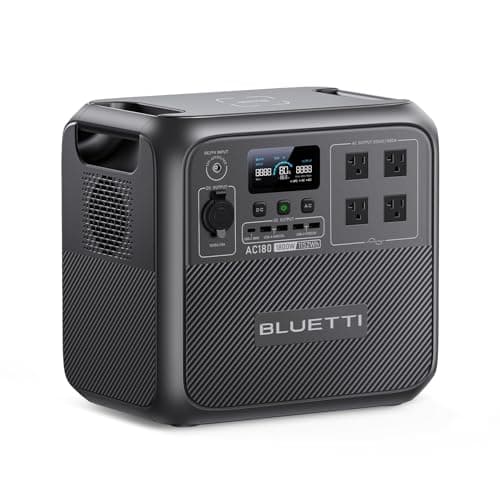 |  |
|---|---|---|---|
| Capacity | 1,002 Wh | 1,152 Wh | 1,024 Wh |
| AC output | 1,000 W | 1,800 W | 2,000 W |
| Surge | 2,000 W | 2,700 W | 3,000 W |
| Chemistry | NMC | LiFePO4 | LiFePO4 |
| Weight | 22 lb | 35.3 lb | 27.6 lb |
| Solar input | 163 W | 500 W | 600 W |
| Warranty | 3 yr | 5 yr | 5 yr |
| Check Price on Amazon | Check Price at BLUETTICode AFF5OFF at checkout | Check Price on Amazon |
Read the full match-up: Jackery vs BLUETTI: Which Brand Wins in 2026? →
Frequently asked questions
How many charge cycles does the Jackery Explorer 1000 last?
Its NMC cells are rated around 500 full charge cycles before noticeable capacity fade. Cycled once a week that's nearly a decade; cycled daily it's under two years. LiFePO4 rivals like the BLUETTI AC180 are rated for 3,500+ cycles — about six times longer.
How many nights will the Explorer 1000 run a CPAP?
With about 850Wh of usable AC output, a CPAP drawing 40W without its humidifier runs roughly 21 hours — two full nights with margin, three if your machine draws closer to 30W. Skip the humidifier and use a DC cord if available to stretch it further.
Can the Jackery Explorer 1000 run a kettle?
No. Electric kettles draw 1,200–1,500W, which exceeds the Explorer 1000's 1,000W continuous inverter and will trip overload protection. It runs fridges, laptops, TVs, and CPAPs fine; for kettles and microwaves you need an 1,800W-class unit like the BLUETTI AC180.
Can I take the Explorer 1000 on a plane?
No. Airline rules allow batteries up to 100Wh in carry-on, or 101–160Wh with airline approval. At 1,002Wh the Explorer 1000 is far beyond both limits and cannot fly on passenger aircraft in carry-on or checked baggage.