Hands-On Review
Anker SOLIX C1000 Review (2026): Best Mid-Size Kit
Our tested review of the Anker SOLIX C1000 + 200W panel kit: 1,056Wh LiFePO4, 1,800W output, a 600W solar ceiling, and six AC outlets in one bundle.

Dominick DePaola
Off-grid power editor at RoverSolar · June 11, 2026
Who It's For
The SOLIX C1000 kit is for the buyer who wants to open one box and be done. Station, 200W folding panel, cables — there's nothing else to research, no compatibility chart to squint at, and no second purchase three weeks later. If you're setting up for RV trips, campsite weekends, or a home-outage plan and the phrase "which panel works with which station" makes your eyes glaze, this bundle is the answer we hand to friends and family.
It's also the right pick for people who expect their needs to grow. The station accepts up to 600W of solar input — triple the bundled panel — so you can add panels later instead of replacing the whole system. That ceiling is the highest among its direct rivals here, and it turns this kit from a fixed product into a starting point.
Who should pass: pure weight-watchers (at 28.4 pounds for the station it's a solid two-hand lift, though lighter than the BLUETTI AC180), and anyone who already owns panels — in that case buy a bare station and pocket the difference. And if you want maximum expandability into whole-home territory, the OUPES Mega 1's add-on batteries take that crown.
Capacity and Output in Practice
The station stores 1,056Wh, which at roughly 85% inverter efficiency gives you about 900Wh of usable AC power. Translated to the field: around 75 phone charges at ~12Wh each, roughly 15 laptop charges at ~60Wh, or about 18 hours of continuous compressor runtime for a 12V fridge drawing 50W — comfortably over a day of real cooling once the compressor's duty cycle is factored in.
For CPAP users, a machine drawing 40W without its humidifier runs around 22 hours — call it three 8-hour nights at low draw, or two with comfortable margin at higher settings. For a long weekend off-grid with the panel topping things up each day, you're effectively unlimited.
The 1,800W inverter handles the loads that embarrass smaller 1kWh units: a 1,200–1,500W kettle boils without complaint, and Anker's SurgePad feature absorbs startup loads up to 2,400W, which covers the inrush from fridge compressors and most power tools. Six AC outlets — double what most rivals offer — mean the whole campsite plugs in directly with no power strip. In our testing the practical pattern was simple: anything short of a space heater or full-size microwave on high, this kit runs it.
Charging: Wall and Solar
The bundled 200W panel is the heart of this kit, and it's a genuinely efficient one — in good midday sun we see strong real-world output, though like every folding panel it won't sustain its full rating all day. Practical math: at a realistic 140–160W average in strong sun, refilling the 1,056Wh station from empty takes roughly seven to eight hours of quality sunlight — a full solar day. The better way to use it is maintenance charging: deploy the panel each morning and it replaces a typical day's fridge, phone, and lighting draw, keeping you indefinitely off-grid for moderate loads.
The spec that elevates this kit is the 600W solar input ceiling. Add a second and third panel down the road and that same recharge compresses to a couple of hours of good sun. None of its rivals in this bundle class give you that much headroom, and it's the reason we call this kit a system you grow rather than a product you outgrow.
One field note: position the panel and re-aim it every couple of hours. The difference between a flat panel and one angled at the sun is real harvest, and with the kickstand's wind sensitivity (more on that below), a low, well-braced angle is both safer and barely less productive.
Build and Portability
The station is a dense, tidy 28.4 pounds — heavier than a Jackery Explorer 1000 but nearly seven pounds lighter than the BLUETTI AC180, which puts it in the comfortable middle of the 1kWh class. The handle and housing feel like Anker hardware usually does: tight seams, no rattle, controls that click with intent. It rides in a truck bed or RV bay without babying.
The port array is the standout. Six AC outlets is the most we've seen in this class, and it changes setup behavior — the coffee maker, the string lights, the fridge, and everyone's chargers all plug straight in. Two USB-C and two USB-A ports plus a 12V car socket round it out. The display is clear about input and output wattage, which makes solar-aiming feedback immediate.
The folding panel is the weaker half of the build story. The fabric and cells are fine, but the kickstand legs feel flimsy when the wind picks up — a strong gust can fold or topple the panel, and a face-down panel harvests nothing. Our field fix is simple: stake the corners or lean it against a cooler, picnic bench, or vehicle tire at a low angle. It works, but it's a workaround the hardware shouldn't need, and it's the one place this kit feels built to a price.
What We'd Change
Start with the panel's kickstand, because it's the kit's only real flaw and we've hit it repeatedly. The legs hold fine in calm conditions, but in gusty weather they lack the stiffness and footprint to keep 200W of sail-shaped fabric upright. Twice in our testing a wind shift laid the panel flat mid-afternoon, costing hours of harvest until someone noticed. Grommets and a set of stakes, or simply stiffer legs with a wider stance, would fix this for pennies. Until Anker does, pack tent stakes and treat windy-day deployment as a rigging job.
Second, we'd like a clearer upgrade story in the box. The 600W input ceiling is this kit's best feature, but the documentation barely mentions what adding panels involves — connector types, series-vs-parallel limits, which Anker and third-party panels play nicely. Buyers who chose a kit precisely to avoid that research deserve a one-page answer.
Finally, minor but real: the station's 2,400W SurgePad covers most startup spikes, but it trails the OUPES Mega 1's 4,000W surge rating, so the very hardest-starting motors are likelier to fault here. For typical fridges and tools it's academic. For a deep-well pump or an older AC unit, check your startup draw before buying.
The Verdict
The SOLIX C1000 kit earns its 8.8 rating by being the bundle we'd actually buy. The station alone is competitive — 1,056Wh of LiFePO4, 1,800W continuous with 2,400W SurgePad, six AC outlets, a 5-year warranty — and the bundled 200W panel makes it a complete, working solar generator on day one. The 600W solar ceiling then future-proofs it in a way no rival bundle here matches.
Against the BLUETTI AC180 — a brilliant station — the practical case for the Anker is the package: the AC180 caps solar at 500W, weighs almost seven pounds more, and arrives without a panel. Against the OUPES Mega 1 kit, the Anker gives up battery expandability and surge headroom but answers with a more polished app-and-hardware experience and the deeper support network of a major brand — a real consideration for a product you'll own for years.
Buy this kit if you want a complete, growable solar power system from a brand that will still answer the phone in five years. Buy the OUPES if expandable capacity is your endgame, or the AC180 if you already own panels. For the most buyers in the middle, this is our pick — just throw a few tent stakes in the panel bag.
How it stacks up
| Spec | 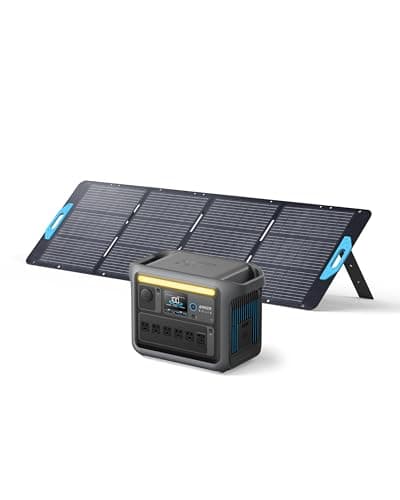 | 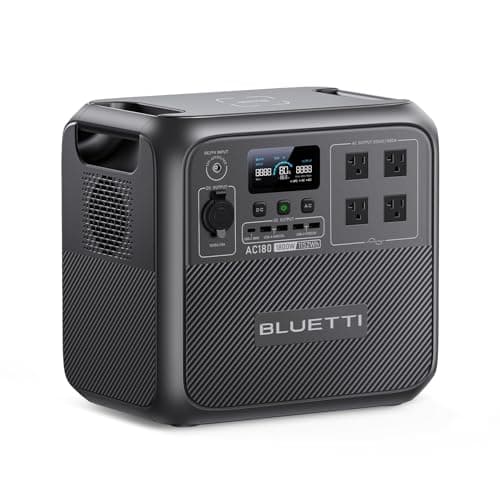 |  |
|---|---|---|---|
| Capacity | 1,056 Wh | 1,152 Wh | 1,024 Wh |
| AC output | 1,800 W | 1,800 W | 2,000 W |
| Surge | 2,400 W | 2,700 W | 4,000 W |
| Chemistry | LiFePO4 | LiFePO4 | LiFePO4 |
| Weight | 28.4 lb | 35.3 lb | — |
| Solar input | 600 W | 500 W | — |
| Panel | 200 W | — | 240 W |
| Warranty | 5 yr | 5 yr | 5 yr |
| Check Price on Amazon | Check Price at BLUETTICode AFF5OFF at checkout | Check Price on Amazon |
Frequently asked questions
How long will the Anker SOLIX C1000's battery last?
The station uses LiFePO4 cells, the long-life chemistry rated for thousands of full charge cycles — roughly a decade of regular use — and Anker backs the kit with a 5-year warranty. That's about six times the cycle life of older NMC stations like the Jackery Explorer 1000.
How many nights of CPAP use does the C1000 kit provide?
With about 900Wh of usable AC output, a CPAP drawing 40W without its humidifier runs roughly 22 hours — two to three 8-hour nights. Deploy the included 200W panel during the day and you can replace each night's usage, extending that indefinitely in decent sun.
Can the SOLIX C1000 run a kettle or coffee maker?
Yes. The 1,800W continuous inverter handles 1,200–1,500W kettles and most coffee makers, and SurgePad absorbs startup loads up to 2,400W for compressors and tools. Sustained loads above 1,800W — large microwaves on high, space heaters — are beyond it.
Can I bring the SOLIX C1000 on an airplane?
No. Carry-on rules cap lithium batteries at 100Wh, or up to 160Wh with airline approval. At 1,056Wh the C1000 is far over the limit and cannot fly. The folding panel itself contains no battery, so it can travel — but the station must go by road.
See every pick: The Best Solar Generators of 2026 (Station + Panel Kits) →