Jackery Explorer 1000 vs BLUETTI AC180: 2026 Duel

Dominick DePaola
Off-grid power editor at RoverSolar · June 11, 2026
These are the two power stations readers ask us about most, and they represent a genuine fork in the road: the lightest proven 1kWh station ever made versus the spec-sheet bully of the class.
We have used both extensively — camping trips, outage duty, and side-by-side bench runs — so this comparison sticks to what the numbers and the field actually show. Short version: the AC180 wins almost every measurable category, and the Explorer 1000 wins the one category you feel in your hands.
| Spec |  | 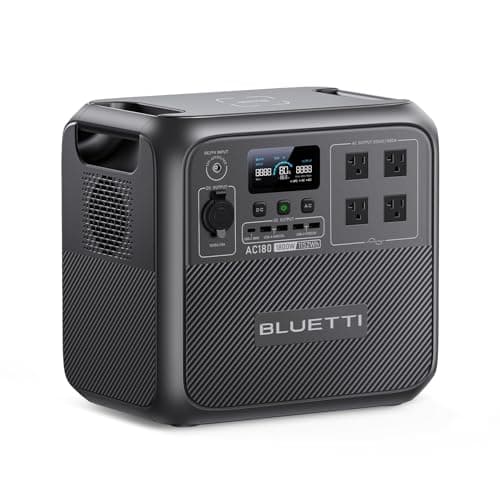 |
|---|---|---|
| Capacity | 1,002 Wh | 1,152 Wh |
| AC output | 1,000 W | 1,800 W |
| Surge | 2,000 W | 2,700 W |
| Chemistry | NMC | LiFePO4 |
| Weight | 22 lb | 35.3 lb |
| Solar input | 163 W | 500 W |
| Warranty | 3 yr | 5 yr |
| Check Price on Amazon | Check Price at BLUETTICode AFF5OFF at checkout |
Spec-by-Spec
On paper this is lopsided. The AC180 carries 1,152Wh to the Explorer 1000’s 1,002Wh — about 15% more stored energy. The inverter gap is wider: 1,800W continuous and 2,700W surge versus 1,000W and 2,000W. In practice that means the BLUETTI runs a microwave, a 1,500W kettle, or a circular saw, while the Jackery taps out at roughly a coffee maker and will fault on heavier resistive loads.
Chemistry compounds the gap. The AC180’s LiFePO4 cells are rated for 3,500+ cycles; the Explorer 1000’s NMC cells are rated around 500. Solar input is 500W versus 163W, wall charging is dramatically faster on the BLUETTI (about 45 minutes to 80%), and the warranty runs 5 years versus 3. The AC180 also adds a 100W USB-C port, a fourth AC outlet, and a wireless charging pad.
The Explorer 1000 answers with exactly one number, and it is a big one: 22 pounds versus 35.3. It is also the simpler machine — fewer modes, fewer menus, nothing to configure. If the comparison ended at the spec table, nobody would buy the Jackery; the next sections explain why some people still should.
Real-World Runtimes
Rated watt-hours never fully reach your devices — inverter losses take their cut — so we plan around roughly 85% usable through the AC outlets: call it about 980Wh from the AC180 and about 850Wh from the Explorer 1000.
What that means in practice: a 12V camping fridge averaging 45W runs roughly 20+ hours on the BLUETTI and roughly 17–18 hours on the Jackery, with both doing meaningfully better through the 12V socket where the inverter stays out of the loop. A 60W laptop recharges a dozen-plus times on either. A CPAP without humidifier, run via a DC adapter, covers several nights on both. For phones, lights, and camera batteries, the difference between these two units is academic — a weekend is comfortable either way.
The runtime story changes when solar enters. With 400W of panel, the AC180 can genuinely refill during a sunny morning, making the effective daily budget far larger than the battery itself. The Explorer 1000’s 163W input cap means solar is a slow trickle by comparison — even with abundant panel, it struggles to refill from a full day of sun while also feeding loads. Off-grid beyond a weekend, that input ceiling becomes the spec that defines the experience.
Portability Trade-Off
Thirteen pounds does not sound like much until you carry it. The Explorer 1000 at 22 pounds moves like a small cooler — one hand, no bracing, no thought. The AC180 at 35.3 pounds is a deliberate two-hand carry for most people, and lugging it across a beach, down a dock, or up apartment stairs is a chore you will notice every single time.
This is the entire case for the Jackery, and we want to make it honestly because it is a legitimate one. If your power station rides in the truck bed to a tailgate, gets carried to a remote fishing spot, or needs to be manageable for an older family member during an outage, the lightest competent 1kWh station on the market has real value that never shows up in a watt-hour column. Jackery also pairs the low weight with a sturdy fixed handle and a compact footprint that tucks behind a seat.
If the station mostly lives in one place — a closet shelf for outages, a van cabinet, a garage bench — the weight difference is irrelevant after the first day, and you are simply giving up capability for a number you will never feel. Be ruthless about which user you actually are; this single question settles the whole comparison for most buyers.
Which One We’d Buy
For most readers, we would buy the BLUETTI AC180, and it is not a close call. Same price bracket, 15% more capacity, an inverter that opens up whole categories of appliances, solar charging fast enough to make off-grid living practical, and LiFePO4 cells that turn it from a two-year gadget into a decade-class tool. The 5-year warranty seals it. Our rating gap — 9.1 versus 8.4 — reflects exactly this.
We would still buy the Explorer 1000 in two specific situations. First, when weight genuinely governs: it remains one of the lightest proven 1kWh stations ever made, and no LiFePO4 rival in this class matches its carry. Second, at clearance prices: NMC-era Jackery inventory gets discounted hard, and for a buyer who will cycle the unit a dozen times a year, 500 cycles is decades of calendar life — the chemistry penalty barely applies.
What we would not do is pay full, equal price for the Jackery as a daily-cycled solar station. At matched prices the AC180 is simply more machine in every dimension a regular user touches: capacity, output, refill speed, lifespan, warranty. Buy the Jackery for your shoulders or your wallet; buy the BLUETTI for everything else.
The bottom line
Buy the Jackery Explorer 1000 if…
Buy the Jackery Explorer 1000 if low weight is your deciding factor or you find it heavily discounted. At 22 pounds it carries like a small cooler, the interface is effortless, and for occasional use — a dozen cycles a year — its 500-cycle NMC chemistry will outlast your patience anyway. It is the right unit for tailgaters, shore fishermen, and anyone who has to hand-carry their power any real distance.
Check Price on AmazonBuy the BLUETTI AC180 if…
Buy the BLUETTI AC180 if you want the most capable station in the class — which is most people. More capacity, an 1,800W inverter that runs real appliances, 500W solar input, roughly 45-minute fast charging to 80%, LiFePO4 cells rated for 3,500+ cycles, and a 5-year warranty, usually at the same price or less. For home backup, regular camping, van life, or any solar-charged routine, it is the clear pick.
Check Price at BLUETTICode AFF5OFF at checkoutFrequently asked questions
Can the Jackery Explorer 1000 run a microwave?
No. Compact microwaves draw 900–1,100W from the wall and surge higher, which sits at or beyond the Explorer 1000’s 1,000W continuous rating — it will typically fault and shut down. The BLUETTI AC180’s 1,800W inverter handles compact and most mid-size microwaves without drama.
How long does each take to recharge from solar?
With enough panel, the AC180’s 500W input can refill its 1,152Wh battery in roughly 2.5–3.5 hours of good sun. The Explorer 1000 is capped at 163W of input, so even with ample panel it needs roughly 7–8 hours of strong sun — most of a perfect day — to refill from empty.
Which one lasts longer?
The AC180, by a wide margin, if you cycle it regularly. Its LiFePO4 cells are rated for 3,500+ cycles to 80% capacity, versus roughly 500 cycles for the Explorer 1000’s NMC cells. Used daily, that is roughly a decade versus under two years before noticeable fade. Used a few times a year, both will last many years.
Is the AC180 too heavy for camping?
It depends on the carry. At 35.3 pounds it is fine for car camping — trunk to picnic table is easy. For anything involving real distance on foot, the 22-pound Explorer 1000 (or a smaller 300–600Wh station) is meaningfully more pleasant. Most AC180 owners simply stop noticing the weight because the unit rarely travels far from the vehicle.